Why Tall Nurses Should Refit Their Scrubs When the Ward Heating Goes On
Quick Answer: Autumn scrubs are worn over a base layer, which changes the effective fit of a garment that was already borderline in length on a tall frame. A long-sleeved base under a scrub top shortens the sleeve, restricts the shoulder and rides the top up at the back when you bend. Refit deliberately: choose a tall scrub top with genuine body length, use a fitted base layer rather than a bulky one, and treat the warm-up jacket as the layer that adjusts rather than adding bulk underneath.
Your scrubs fitted fine all summer.
First week of the heating going on, you added a long-sleeved top underneath and now the sleeves are short, the back rides up every time you bend, and you spend the shift adjusting.

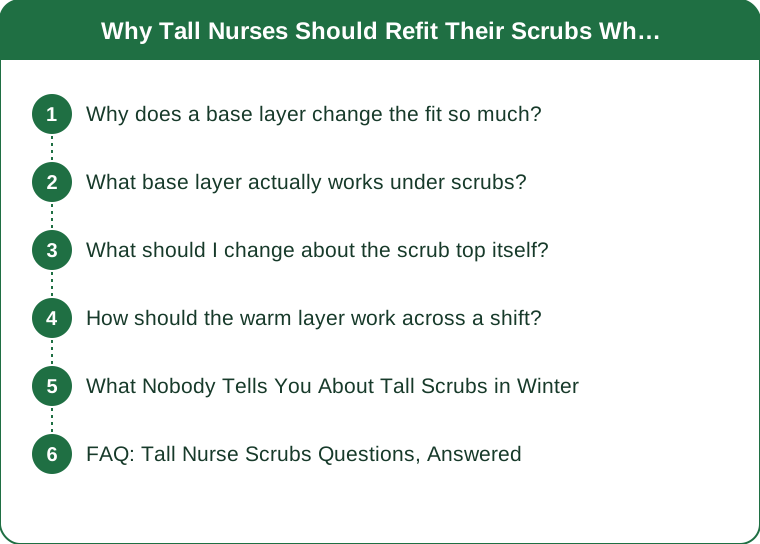
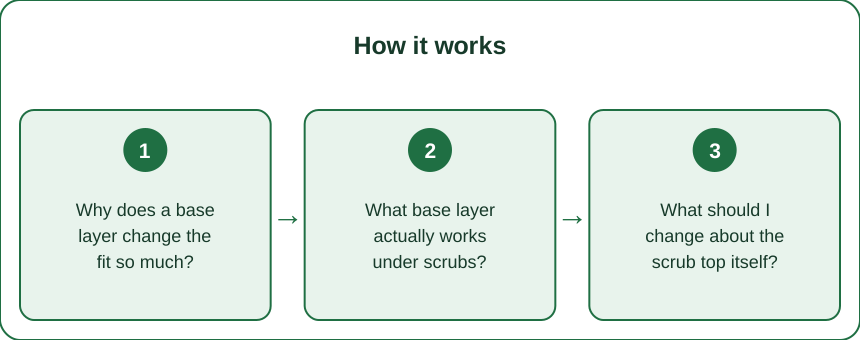
Why does a base layer change the fit so much?
Because it adds a layer of friction as well as a layer of fabric. A base layer grips the scrub top and drags it upward every time you bend or reach.
On a long torso the scrub top was already close to its length limit, so any upward movement exposes the back immediately.
Sleeve length is affected twice - the base layer sleeve shows past the scrub sleeve, and the scrub sleeve itself rides up on the added bulk.
Shoulder mobility reduces when two layers with different stretch characteristics are combined, which is noticeable during patient handling.
And the neckline changes, which matters for both comfort and appearance over a long shift.
None of this shows in a fitting room in August, which is when most people last assessed their scrubs.
What base layer actually works under scrubs?
Fitted rather than loose, which minimises bulk and reduces the friction that drags the scrub top upward.
Longline in the body, so the base layer itself does not ride up under a tall frame’s movement.
Smooth fabric rather than textured, which reduces grip against the scrub top and lets it move independently.
Thin and breathable rather than warm, since ward temperature varies dramatically and a thick base layer that felt right in a cold corridor is unbearable in a warm bay.
Long-sleeved base layers need to be appropriate for your workplace policy, which varies by setting and by clinical area - check yours rather than assuming.
And have two, because a base layer worn under scrubs for a twelve-hour shift is a laundry item, not a wardrobe item.
What should I change about the scrub top itself?
Prioritise body length over everything else when choosing a tall scrub top. Sleeve length is more visible; body length is what determines whether you spend the shift adjusting.
Check the length by bending forward fully, which is the position that exposes the problem and the position you will be in repeatedly.
Look for a slightly longer back hem, which some designs include and which solves most of the riding-up problem on a long torso.
Check the sleeve with your arm raised, not by your side, since reaching above shoulder height is a routine part of the job.
Consider a size longer specifically for winter, keeping the summer fit for summer, which is more practical than one compromise fit for the year.
And check the pocket position, which is set for average torso length and often lands too high to be usable on a tall frame.

How should the warm layer work across a shift?
Use a warm-up jacket over the scrubs as the adjustable layer, rather than adding bulk underneath where it cannot be removed.
Choose one with genuine sleeve length, which is the perennial tall complaint in healthcare outerwear and is worth searching for specifically.
It should come on and off in one movement, since the point is adapting to ward temperature swings quickly.
Check the workplace policy on outer layers in clinical areas, which varies and is not always the same as the policy on base layers.
Keep it accessible rather than in a locker, or it will not be used and you will add a base layer instead.
And consider your commute separately, since a warm-up jacket is not outerwear and the walk in and out is its own problem in autumn.
What Nobody Tells You About Tall Scrubs in Winter
Body length matters more than sleeve length, and everyone shops for sleeve length. A short sleeve is visible and mildly annoying. A short body means adjusting your top after every bend for twelve hours, which is genuinely exhausting.
Two seasonal fits beats one compromise fit. Buying a set of scrubs a size longer for winter layering is cheaper than the wear on your summer set and far more comfortable than one fit that works badly in both seasons.
Ward temperature is not one temperature. Corridors, bays, treatment rooms and store rooms can differ by ten degrees or more, and dressing for the average means being wrong most of the time. An easily removable outer layer beats a warmer base layer for this reason alone.
Trouser rise is the other tall problem and nobody mentions it. A rise that sits too low under a long torso is uncomfortable in every position and worse when bending, which is most of the shift. Check the rise, not just the inseam.
Compression socks in tall sizing exist and most people do not know it. Standard compression socks on a long calf either fall down or dig in at the top, and neither is doing the job they were bought for.
And the base layer is a laundry item. Worn against the skin for a twelve-hour shift, it needs washing every time, which means owning several rather than one. This is general information, not medical advice.
FAQ: Tall Nurse Scrubs Questions, Answered
What should I check first when buying tall scrubs?
Body length, tested by bending fully forward. It determines whether you spend the shift adjusting, and it is less obvious than sleeve length in a fitting room.
Is a long-sleeved base layer allowed under scrubs?
It depends entirely on your workplace policy and clinical area. Check your local uniform policy rather than assuming, as requirements vary significantly.
Should I buy different scrubs for winter?
Many tall staff find a slightly longer winter set more practical than one year-round compromise, since layering changes the effective fit substantially.
What base layer works best?
Fitted, longline, smooth-fabric and thin. Bulk and texture both increase the friction that drags a scrub top upward.
How do I stop my scrub top riding up at the back?
Longer body length, a smooth base layer and a design with a slightly dropped back hem. It is a fit problem rather than a tucking problem.
Do tall compression socks exist?
Yes, and they are worth seeking out. Standard sizes on a long calf tend to either slide down or constrict at the top, neither of which delivers the intended effect.
What about trouser rise?
Check it specifically. On a long torso, rise rather than inseam is usually what makes a scrub trouser uncomfortable, and it is rarely listed on the product page. This is general information, not medical advice.
TL;DR:
- A base layer adds friction as well as fabric, dragging a scrub top upward every time you bend.
- Choose base layers that are fitted, longline, smooth and thin - not warm and bulky.
- Prioritise scrub body length over sleeve length, and test it by bending fully forward.
- Use a warm-up jacket as the adjustable layer, since wards swing ten degrees between areas.
- Check trouser rise, not just inseam, and look for tall compression socks.
Refit for the season rather than compromising across both. This is general information, not medical advice.
Keep Reading
This article is for general informational and styling purposes only. Fit, sizing, and product availability may vary.
