Why Tall Nurses Lose the Most in the Last Two Hours of a Shift
Quick Answer: Working at a surface below your ideal height requires continuous low-level muscular effort to hold a flexed position. That effort is easy to sustain early and expensive late, because postural muscles fatigue in a non-linear way. A tall nurse working at surfaces set for average height accumulates several hours of extra static load over a twelve-hour shift, which is why the last two hours feel disproportionately worse.
Hours one to eight are fine. Hour ten is a different job.
That is not stamina. That is a debt that has been building since handover.

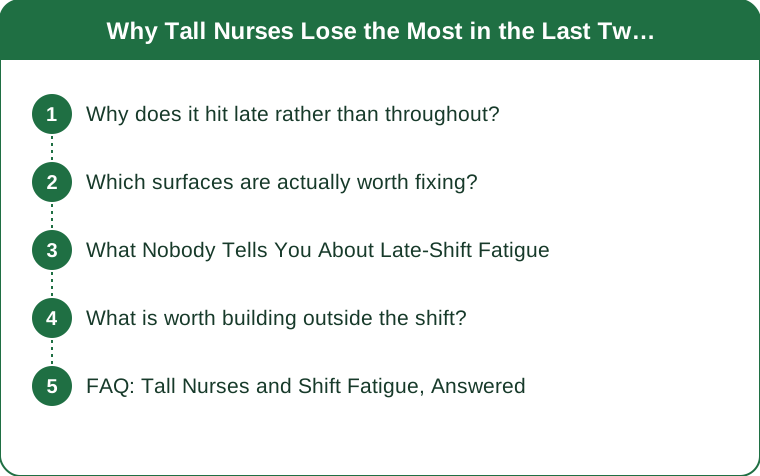
Why does it hit late rather than throughout?
Because static postural work has a fatigue curve that is flat and then steep.
Holding a slightly flexed spine is low-intensity muscular work, and low-intensity work can be sustained for a long time — until the specific motor units doing it fatigue. Because the load is constant, the same fibres are recruited continuously rather than rotating, which is what makes static postures more fatiguing than intermittent movement at a higher load.
When those fibres fatigue, the body recruits compensations, and the compensations are less efficient. Your lumbar spine takes more of the flexion, your neck takes more of the forward reach, and the same task starts costing more. That is the transition people feel somewhere in hour eight or nine.
Meanwhile the tasks themselves get harder. Documentation piles up toward the end of the shift, and documentation is the most static, most poorly positioned activity in the whole job. The worst ergonomic task arrives at the worst time.
Tall nurses accumulate this faster because more of the environment is below their neutral working height: beds, workstations, trolleys, computer screens on wall mounts, and sinks. There is no single dramatic bad posture. There are twenty slightly bad ones, all day.
The compounding is the point. If each interaction costs you a little more than it costs a colleague of average height, and you have several hundred interactions in a shift, the difference at hour ten is not marginal.
Which surfaces are actually worth fixing?
The ones you use repeatedly, in order of how often you use them.
Bed height, every single time. This is the highest-value habit in the job. Beds are adjustable, adjusting takes three seconds, and almost everyone skips it for quick tasks. For a taller nurse the default height is well below your neutral, and it is the single largest contributor. The rule that works is: adjust for anything that will take longer than thirty seconds, and adjust to your own height rather than to the last person’s.
The computer on wheels. Most have height adjustment that nobody uses. Set it once at the start of a shift for your own height and it stays. Screen height matters as much as keyboard height — a screen below eye level for hours is what produces the end-of-shift neck ache.
Wall-mounted workstations are the hardest problem, because they are fixed and usually set low. Where possible, standing further back and using the mouse and keyboard at arm’s length is better than leaning in. If the screen has any tilt adjustment, tilting it up is a small but real gain.
The medication trolley. Rarely adjustable and used constantly. What helps is turning your whole body to face it rather than reaching and rotating, and putting a foot on the lower rail if there is one — which unloads the lower back meaningfully.
Sinks. Not adjustable, used dozens of times, and low for a tall person. Widening your stance to lower your hips rather than bending your back is the practical fix, and it becomes automatic quickly.

What Nobody Tells You About Late-Shift Fatigue
Your judgement degrades alongside your posture. The late-shift period is when both the ergonomic compensations and the cognitive fatigue arrive, which is exactly when the awkward unplanned lift or the rushed patient reposition is most likely to happen. Being deliberate about asking for help late in a shift matters more than it does early.
Compression socks are sized by shoe size, which fails tall wearers. A tall nurse frequently needs a longer length than the shoe-size chart suggests, and a sock that is too short applies its graduated pressure in the wrong place, which is worse than not wearing them.
Shoes matter more in the second half. Cushioning compresses through a shift, and a shoe that felt fine at hour two is providing measurably less at hour ten. Rotating between two pairs across shifts extends the useful life of both and gives the foam time to recover.
Micro-breaks beat one long break. Thirty seconds of standing upright, shoulders back, looking at something far away, done every hour, does considerably more for postural fatigue than a single twenty-minute sit-down. The problem is static loading, and the antidote is interruption rather than duration.
Hydration affects postural fatigue more than people expect, and nurses are notoriously under-hydrated by hour eight. Muscle fatigue arrives sooner in a dehydrated state, and the relationship is not subtle.
And the first shift after days off is often the worst, not the last of a run. Postural tolerance detrains slightly, and the first twelve-hour shift back reintroduces the whole load at once. Knowing this is why experienced staff protect their first shift back rather than treating it as the easy one.
What is worth building outside the shift?
A small amount of specific capacity, because the demand is unavoidable and can only be met rather than removed.
Posterior chain strength. Hip hinge work — deadlifts, Romanian deadlifts, hip thrusts — builds exactly the capacity that repeated bending demands. Two short sessions a week is enough to change how hour ten feels.
Isometric endurance for the upper back. The failure mode is postural muscles fatiguing, so training them for endurance rather than strength is what transfers. Prone holds, band pull-aparts and wall angels, done for time rather than for load.
Thoracic mobility. A stiff upper back forces the lower back and neck to take more range, which is the mechanism behind most of the late-shift complaints. Ten minutes a few times a week is disproportionately effective.
Calf and foot work, which is neglected and matters enormously for twelve hours of standing. Calf raises and simply spending time barefoot at home both help.
And the seasonal note that catches people out: as the ward heating goes on, scrubs that were comfortable in August become too warm, and overheating accelerates the perception of fatigue considerably. Refitting your scrub layers for the heated ward — and particularly dropping the under-layer that made sense in summer — is a small change that makes hour ten measurably better.
General information, not medical advice. Back pain that radiates, comes with numbness or weakness, or persists beyond a couple of weeks is worth having assessed properly — occupational health exists for exactly this and is under-used.
FAQ: Tall Nurses and Shift Fatigue, Answered
Is it reasonable to adjust the bed for every single task?
Yes, and it is the standard manual handling recommendation rather than a personal preference. The three seconds is genuinely the best return available in the whole job. If a colleague has left it low, raising it is not rudeness — it is what the adjustment is for.
Do standing mats help?
On fixed workstations where you stand for long documentation periods, yes, noticeably. They encourage small postural shifts and reduce the static loading on the feet and lower back. They are less useful in areas where you move constantly, and they can be a trip hazard in busy corridors, so placement matters.
Should I be doing stretches during the shift?
Movement, more than stretching. The problem is a held position, so the useful intervention is changing position — standing tall, walking, reaching overhead, rotating the spine gently. Thirty seconds an hour beats a stretching routine at the end, which is treating the symptom after the damage is done.
TL;DR:
- Static postural load has a flat-then-steep fatigue curve, so surfaces that are slightly too low cost you at hour ten rather than hour two.
- Tall nurses face twenty slightly-wrong heights rather than one obviously bad one, and it compounds across hundreds of interactions.
- Adjust bed height every time, set the computer on wheels once per shift, widen your stance at sinks, and turn your feet rather than twisting.
- Micro-breaks every hour beat one long break; rotate shoes; check compression sock length by leg rather than shoe size.
- Build hip hinge strength and upper-back endurance outside work, and refit your scrub layers when the ward heating goes on.
The useful reframe is that the last two hours are not a stamina problem to push through — they are the bill for eight hours of small ergonomic compromises. Most of those compromises are three-second fixes, which means the bill is largely optional.
Keep Reading
This article is for general informational and styling purposes only. Fit, sizing, and product availability may vary.
