Why Tall Nurses Should Choose Shoes by the Ward Floor, Not the Brand
Quick Answer: Hard vinyl and concrete-backed hospital floors give almost no shock absorption, so all of it has to come from your shoe. A taller, heavier frame generates greater ground reaction forces with every step, so the same shoe that works for a shorter colleague on the same ward may be genuinely inadequate for you. Choose cushioning and stability by your floor and your frame, not by ward recommendation.
A colleague swears by a particular clog. You buy the same clog.
By hour nine your feet are worse than they were before.
They were not wrong. You are just landing harder on the same floor.

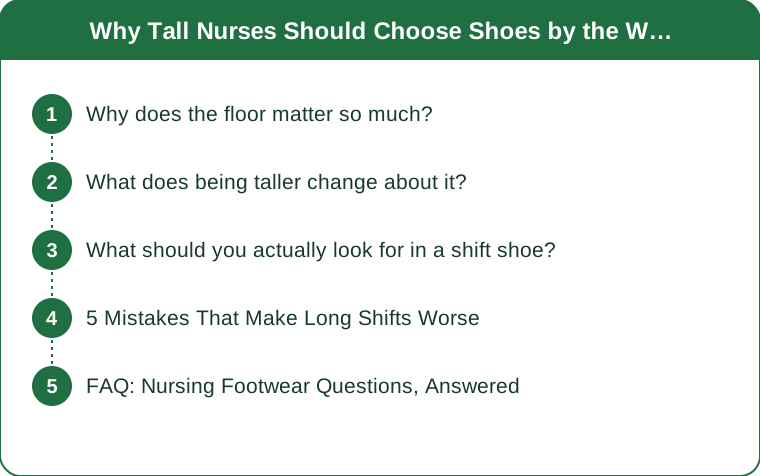
Why does the floor matter so much?
Because hospital flooring is chosen for infection control and durability, and cushioning is not on the list.
Most clinical areas use sheet vinyl or safety vinyl over concrete screed, which is dense, easy to clean, and essentially non-compliant underfoot. Some areas — offices, some day units, occasionally staff rooms — have carpet or cushioned vinyl, which behaves completely differently.
Because the floor absorbs almost nothing, every bit of shock attenuation has to come from your footwear, your foot and your joints. Over a twelve-hour shift with, commonly, 12,000 to 20,000 steps, that is a very large number of small impacts.
This is why ward-to-ward variation matters. A nurse moving from a carpeted outpatient area to a hard-floored acute ward often experiences new foot pain and assumes something has changed in their body. What changed was the surface.
What does being taller change about it?
Ground reaction force, primarily, and the leverage of any misalignment.
Each step generates a force roughly proportional to your body mass, and taller people are generally heavier. The peak force in walking is commonly around 1.2 times body weight, so a difference of 15 to 20 kilos between two colleagues translates into a meaningfully larger load per step, repeated tens of thousands of times.
Longer limbs also mean longer levers. A small deviation in foot mechanics — mild overpronation, say — produces a larger rotational demand at the knee and hip when the shin and femur are longer. Issues that a shorter colleague might never notice can become genuinely symptomatic on a taller frame.
And there is a simple sizing problem. Larger shoe sizes are often scaled up from a smaller last rather than redesigned, so midsole thickness and arch support position may not scale with the foot. A size 9 or 10 may have proportionally less support at the arch than a size 5 in the same model.

What should you actually look for in a shift shoe?
Four things, in this order.
Genuine midsole cushioning. A thick, resilient EVA or foam midsole does the job that the floor is not doing. Traditional hard-soled clogs are easy to clean and, for many taller nurses on hard floors, insufficiently cushioned for a twelve-hour shift.
Stability, not just softness. Very soft shoes without structure allow the foot to collapse, which fatigues the arch. Look for a shoe that is cushioned and has a firm heel counter — squeeze the back of the heel, and it should resist.
A slight heel-to-toe drop. Something in the region of 6 to 10mm tends to be more comfortable for prolonged standing than a fully flat shoe, particularly for anyone with tight calves.
Fit at the end of the day. Feet swell over a shift, sometimes by a half size. Try shoes on in the evening, and leave a thumbnail of space at the toe.
And rotate. Two pairs alternated outlast three worn consecutively, because foam needs 24 hours to decompress fully. This is the cheapest improvement available and almost nobody does it.
5 Mistakes That Make Long Shifts Worse
1. Buying the shoe your colleague recommends. Different weight, different foot, different arch, sometimes a different ward floor. Recommendations are a starting point, not a prescription.
2. Wearing one pair until it is visibly worn out. Midsole foam loses a large share of its cushioning long before the upper looks tired — often at around 500 to 800 kilometres, which for a full-time nurse can be six months or less.
3. Ignoring compression socks. For prolonged standing, graduated compression genuinely helps with swelling and end-of-shift heaviness. This is one of the better-supported interventions for shift workers on their feet.
4. Standing still rather than moving. Static standing is harder on the venous system than walking is. Where the work allows, shifting weight and taking a few steps regularly is better than holding one position.
5. Not adjusting other kit for height. Bed height, trolley height and monitor height all matter, and all are usually left where the last person set them. Raising a bed before you work at it is a two-second habit that saves a great deal.
This is general information, not medical advice. Persistent foot, knee or back pain warrants assessment by a qualified professional — and many trusts have occupational health services worth using.
FAQ: Nursing Footwear Questions, Answered
Are running shoes acceptable on a ward?
Where local policy allows a closed, non-slip shoe, many nurses find a stability running shoe the most comfortable option by a wide margin. Check your local uniform and infection control policy first, since fluid-resistant requirements vary.
How often should I replace them?
By distance and time, not appearance. For a full-time clinical role, plan on replacing every six months and sooner if you notice new aches that resolve on days off.
Do insoles help?
Over-the-counter cushioned insoles can help, particularly in a shoe whose midsole is thin. For persistent, specific problems — plantar heel pain, for instance — a podiatrist assessment is a better route than trial and error.
TL;DR:
- Hospital vinyl over concrete absorbs almost nothing, so all shock attenuation has to come from your shoe.
- A taller, heavier frame generates larger forces per step and longer levers, so the same shoe performs differently for you.
- Prioritise midsole cushioning plus a firm heel counter, fit shoes in the evening, and rotate two pairs.
- Replace by distance and time, not by how the upper looks, and use compression socks for long shifts.
The shoe your colleague loves is information about their shift, not yours. The floor is the same; what you put between you and it should not be.
Keep Reading
This article is for general informational and styling purposes only. Fit, sizing, and product availability may vary.
