Why Tall Nurses Should Choose Stethoscope Tubing Length Deliberately
Quick Answer: Standard stethoscope tubing runs about 55 to 69 cm (22 to 27 inches), which is designed around an average-height clinician at an average bed height. Tall nurses generally want the longer end of the range - 69 cm or more - because short tubing forces you to bend further toward the patient on every listen. Longer tubing does slightly reduce sound transmission, so the trade is real: go one step longer than standard, not the longest available, and raise the bed instead wherever you can.
Here is the trade-off and how to decide.

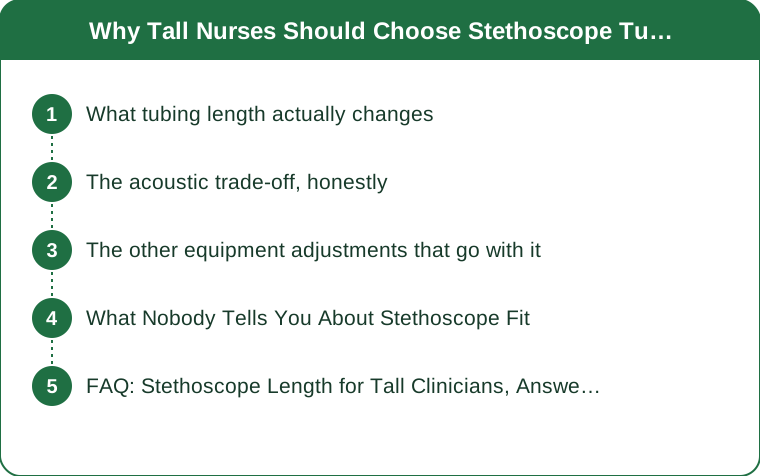
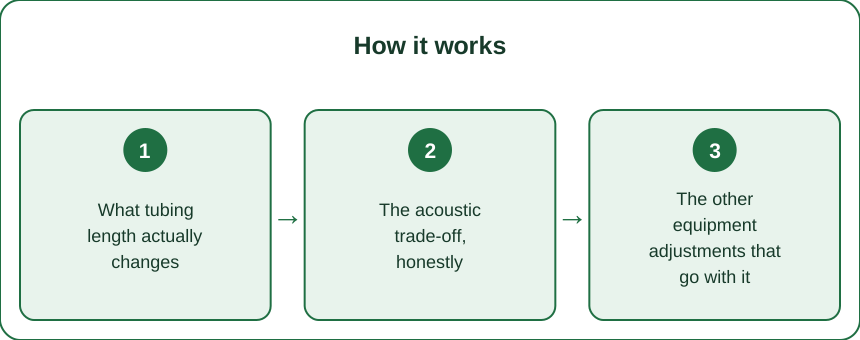
What tubing length actually changes
Tubing length determines how far your ears have to travel toward the chest piece, and therefore how much you bend on every auscultation.
Standard lengths cluster around 55 to 69 cm. Most manufacturers offer a short (around 55 cm), a standard (around 66 cm), and a long (69 cm or more) in the same model, which many clinicians do not realise.
Short tubing means bending forward and down to close the distance. Repeated across a shift - and a busy ward round can involve dozens of auscultations - that is a meaningful amount of cumulative flexion.
Tall clinicians bend further for the same bed height, because the distance from their ears to a patient’s chest is greater. A tubing length that is comfortable for a 165 cm colleague is not for someone at 180.
The bend is usually forward and slightly rotated, since you are also positioning the chest piece with one hand. That combination is the one most associated with lower back strain.
And it is invisible as a problem. Nobody attributes end-of-shift back ache to a stethoscope, which is exactly why it goes unaddressed for years.
The acoustic trade-off, honestly
Longer tubing does reduce sound transmission somewhat. Sound energy attenuates over distance in the tubing, and the effect is real - which is why manufacturers do not simply make everything long.
The practical difference is modest for most uses. For routine cardiovascular and respiratory assessment, a step from 66 to 69 cm is unlikely to change what you can hear, particularly with a good quality instrument.
It matters more for subtle findings. Faint murmurs and quiet breath sounds are where any loss of transmission shows up first, so clinicians who rely on fine auscultation should weigh it more heavily.
Tubing thickness and material matter as much as length. Thicker-walled tubing transmits better, so a longer tube in a good material can outperform a shorter tube in a poor one.
Better instruments tolerate longer tubing better. If you are going long, this is a reason to buy a quality stethoscope rather than the cheapest available - the acoustic headroom absorbs the trade.
The sensible answer for most tall nurses is one step longer than standard, not the longest available. You get most of the postural benefit with minimal acoustic cost.
And electronic stethoscopes sidestep the trade entirely by amplifying, which is worth knowing if your unit provides them or if hearing is a consideration.

The other equipment adjustments that go with it
Raise the bed first, every time. This is the fix that costs nothing and helps most. Beds should come to a height where you are upright, and a stethoscope choice is a supplement to that, not a substitute.
The obstacle is that raising and lowering takes seconds and feels like a delay. It is not - it is the highest-value ergonomic habit in ward nursing, and the seconds are trivial against a shift.
Check the ear tip angle. Ear tubes should angle forward, following the direction of the ear canal. Wearing them backwards is common and reduces both comfort and sound - and it makes people lean in closer to compensate.
Adjust the headset tension if it is adjustable. Too loose and the seal fails, so you press the chest piece harder and lean in further. Many models allow the spring tension to be adjusted by gently bending the yoke.
Wear it around the neck rather than in a pocket if the tubing is long - a long tube in a pocket tangles and drags, which is the main practical objection to longer tubing.
Consider where you stand. Approaching from the side that lets you keep your back straight, rather than always from the same side out of habit, is free and effective.
And check the rest of your kit for the same problem. Tall nurses frequently find that badge reels, pen lights, and scissors on a short lanyard all pull them into the same forward lean.
What Nobody Tells You About Stethoscope Fit
Most nurses buy whatever the shop had, once, at the start of their career - and then use it for a decade. Tubing length is rarely a considered decision, and it is one of the few pieces of kit you fully control.
Manufacturers list tubing length in the specifications, and it varies more than people assume between models that look identical. It is worth checking before buying rather than after.
Longer tubing tangles more. This is the real day-to-day cost, not the acoustics. Wearing it around the neck rather than in a pocket largely solves it.
Tubing stiffens and cracks with age, which affects sound quality regardless of length. Rubbing against a badge or an ID clip accelerates it, and most tubing has a working life of a few years.
Cold weather stiffens tubing noticeably. In a cold ward or after time in a car in autumn, stiff tubing transmits differently and is less comfortable for the first few minutes.
Two-tube designs generally transmit better than single-lumen ones that split near the top, though modern single-lumen designs have narrowed the gap considerably.
And your own hearing matters more than the tubing. If auscultation has become harder over a career, that is worth an audiology check rather than an equipment upgrade. This is general information, not medical advice.
Ask a tall colleague what they use. It is the fastest route to a good answer, and this is exactly the kind of practical knowledge that never gets written down on a ward.
FAQ: Stethoscope Length for Tall Clinicians, Answered
What tubing length should a tall nurse choose?
One step longer than standard - typically 69 cm or more where the standard is around 66 cm. That captures most of the postural benefit without a meaningful acoustic cost.
Does longer tubing really reduce sound quality?
Yes, but modestly. Sound attenuates over distance, and the effect shows up first with faint murmurs and quiet breath sounds. For routine assessment, one step longer is rarely noticeable.
Why does tubing length affect my back?
Short tubing means bending forward and slightly rotating on every auscultation. Tall clinicians bend further for the same bed height, and a busy shift involves dozens of repetitions.
Should I just raise the bed instead?
Yes - and also. Raising the bed is the highest-value ergonomic habit available and costs nothing. Tubing length is a supplement to that, not a replacement for it.
Are my ear tips angled correctly?
They should angle forward, following the direction of your ear canal. Wearing them backwards is common, reduces sound and comfort, and makes people lean in further to compensate.
How long does stethoscope tubing last?
A few years of regular use. It stiffens and cracks with age, and rubbing against badges or ID clips accelerates it. Stiff tubing transmits differently, particularly in cold weather.
What is the practical downside of longer tubing?
Tangling, not acoustics. Wearing it around your neck rather than stuffed in a pocket resolves most of it.
TL;DR:
- Standard tubing is 55 to 69 cm, designed around average height and average bed height. Most models offer short, standard, and long in the same range.
- Go one step longer than standard - not the longest available. Most of the postural benefit, minimal acoustic cost.
- Longer tubing does attenuate sound, and it shows first on faint murmurs and quiet breath sounds.
- Raise the bed first, every time. It costs nothing and it is the highest-value habit in ward ergonomics.
- Check your ear tips angle forward - wearing them backwards is common and makes you lean in to compensate.
- The real cost of long tubing is tangling. Wear it round your neck rather than in a pocket.
- Tubing has a working life of a few years and stiffens with age and cold.
Check the rest of your kit for the same pattern - short lanyards, badge reels, and pen lights all pull you into the same forward lean. If auscultation has got harder over a career, that is an audiology question, not an equipment one; this is general information, not medical advice.
Keep Reading
This article is for general informational and styling purposes only. Fit, sizing, and product availability may vary.
