Why Tall Nurses Run Hotter in Summer Scrubs Than Anyone on the Unit
Quick Answer: Heat loss depends on airflow across skin and on evaporation, and scrubs sized for length on a tall frame usually end up pulled taut across the torso and shoulders, which eliminates the air gap that makes fabric breathable. Add more steps per shift, more absolute heat production, and a garment that fits worst exactly where you sweat most, and the same uniform performs differently on a taller body. It is a fit problem more than a fabric problem.
Drape, not fabric weight, is what keeps you cool.

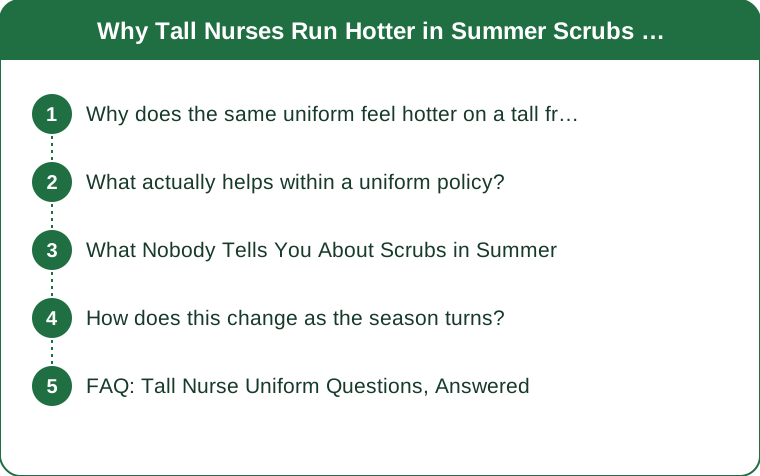
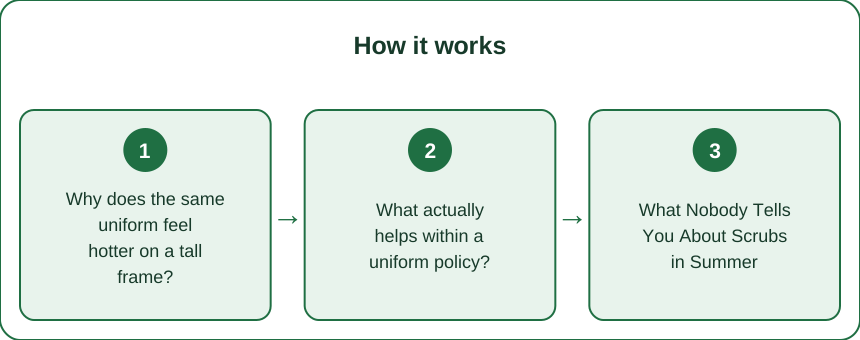
Why does the same uniform feel hotter on a tall frame?
Because fabric only breathes when there is space between it and your skin.
Clothing keeps you cool through two mechanisms. Air movement between the fabric and the skin carries heat and moisture away, and evaporation of sweat into that moving air removes a large amount of heat. Both depend on a gap.
When a garment is pulled taut, that gap closes. Fabric in direct continuous contact with skin conducts heat rather than ventilating it, and sweat wicks into the fabric and stays there rather than evaporating into moving air.
Tall sizing frequently fixes the length problem and not the width problem. A scrub top sized to reach the hip on a long torso is often pulled tight across the shoulders and upper back, and the upper back is where the largest concentration of active sweat glands sits.
Sleeve and armhole fit matter disproportionately. The armhole is the primary air exchange point in a top — air enters at the hem and exits at the sleeve. A tight armhole closes the circuit, which is why a top that fits well elsewhere can still feel airless.
The rest of the picture:
More total heat production. A larger body doing the same work generates more heat in absolute terms, and more of it needs to be shed.
More distance walked. Ward work is high step count, and a longer stride covers more ground per step, and taller staff are frequently the ones sent for things. The workload is not identical across a team.
Standing heat load is real. Static standing in warm air with poor airflow, for hours, is thermally different from moving.
Warmer units. Patient comfort dictates ward temperature, and it is set higher than would be comfortable for someone working in it.
What actually helps within a uniform policy?
Fit changes and layering, both of which are usually permitted.
Buy for drape, not for tightness. A scrub top that skims rather than clings is cooler at the same fabric weight, because it restores the air gap. This is the single largest available improvement.
Prioritise the armhole and shoulder fit when choosing. Raise your arms overhead in the fitting room. If the top lifts your waistband or binds across the back, the armhole is too tight, and it will be airless by hour four.
Look for genuine tall sizing rather than sizing up. Sizing up for length adds width everywhere and produces a top that is baggy at the waist and still short. Tall grading adds torso and sleeve length, which is what you need.
Fabric composition matters, and less than fit. Lighter weight, moisture-wicking blends move sweat outward faster. Four-way stretch fabrics tend to sit closer to the body, which looks neat and reduces airflow, so there is a genuine trade-off there.
Choose the right base layer, or none. A cotton undershirt holds sweat against the skin all shift. If you wear one, make it a wicking synthetic or merino, not cotton.
Scrub trousers: check the rise, not just the inseam. A rise that is too short on a long torso pulls the waistband down and the crotch up, which binds at the top of the thigh — a hot, chafe-prone area on a long shift.
Use the breaks properly. Cool water on the forearms and wrists for a minute genuinely lowers core temperature, and it is fast enough for a real break. Forearm cooling is efficient and underused.
Hydrate on a schedule, not on thirst. Twelve-hour shifts with limited breaks make thirst a poor guide, and a taller frame loses more fluid in absolute terms for the same conditions.

What Nobody Tells You About Scrubs in Summer
Dark scrubs are hotter outdoors and identical indoors. Colour matters for radiant heat from the sun, which is a factor on the walk in and irrelevant on the ward.
Compression socks are non-negotiable and they are warm. They are worth the heat cost for the venous return benefit over a long shift, and choosing a lighter compression weight in summer is a reasonable compromise. Tall staff frequently need a longer sock length than standard, and a sock that is too short rolls and constricts.
Wet fabric against skin cools you only while it is evaporating. Once a scrub top is saturated and pressed against your back, it is an insulating wet layer. A spare top halfway through a summer shift is transformative and almost nobody carries one.
The commute is part of the thermal load. Arriving already hot means starting the shift with an elevated core temperature and a fluid deficit.
Shoes matter for heat too. Feet swell over a long shift, more so in heat, and a shoe that fits at 7am can be genuinely tight by 5pm. Sizing for the end of the shift rather than the start is the right approach.
Hair off the neck makes a measurable difference, because the neck is a high-blood-flow area close to the surface.
Air conditioning zones vary hugely within a building. Some units run cold, some run warm, and staff who move between them experience repeated thermal swings that are more fatiguing than a single consistent temperature.
How does this change as the season turns?
The problem shifts rather than disappearing, and the transition weeks are the hardest.
Late August is still peak indoor heat load in many facilities, because building thermal mass lags outdoor conditions and cooling systems run at their limit. The hottest wards of the year are often in late August rather than July.
Outdoor commutes cool before indoor conditions do. For several weeks the pattern is a cool walk in, a hot shift, and a cool walk out, which means you need a layer for the commute and a lighter one for the ward — and carrying both is the practical answer.
Heating season brings a different problem. Once heating turns on, indoor air becomes dry as well as warm, which affects skin, eyes, and voice. The fluid requirement does not fall when the season changes, and most people reduce their intake anyway.
Autumn is the sensible time to replace worn scrubs. Fabric that has been washed at high temperature all summer loses its wicking finish and its shape, and a stretched-out top clings differently than a new one.
Sock and shoe review is worth doing at the same time. Compression socks lose their compression over months of washing, and shoes worn through a summer of long shifts are usually past their supportive life.
One practical thing to start now: keep a spare top and a small towel in your locker. It is a small intervention with a disproportionate effect on how the second half of a shift feels.
This is general comfort guidance rather than medical advice. Symptoms like dizziness, palpitations, or persistent swelling in the legs after shifts are worth discussing with occupational health rather than working around.
FAQ: Tall Nurse Uniform Questions, Answered
Why do scrubs feel hotter on me than on colleagues?
Usually because a top sized for your length is pulled tight across the torso and shoulders, closing the air gap that makes any fabric breathable. Fit determines airflow more than fabric does.
What should I check when buying scrubs?
Raise your arms overhead. If the hem lifts significantly or the back binds, the armhole and shoulder are too tight and the top will be airless on a long shift.
Do more expensive scrubs run cooler?
Not reliably. Some premium four-way stretch fabrics fit closer to the body, which looks sharp and reduces airflow. Drape matters more than price.
Is a base layer under scrubs a good idea?
Only if it wicks. A cotton undershirt holds sweat against your skin for the whole shift. A thin wicking synthetic or merino layer can help; cotton makes it worse.
TL;DR:
- Fabric only breathes when there is an air gap, and tall sizing often solves length while leaving the torso pulled taut.
- Armhole and shoulder fit control airflow more than fabric weight does — test by raising your arms.
- A larger frame produces more heat and covers more ground, so the same uniform performs differently.
- Keep a spare top in your locker, cool your forearms on breaks, and replace summer-worn scrubs in autumn.
Raise your arms in your current scrub top. If the hem lifts, that is your heat problem.
Keep Reading
This article is for general informational and styling purposes only. Fit, sizing, and product availability may vary.
