Why Compression Socks Sized by Shoe Size Fail Tall Nurses
Quick Answer: Graduated compression socks are engineered as a pressure map — tightest at the ankle, easing up the calf — and that map is drafted for an average lower-leg length and circumference. Sizing by shoe size assumes your calf matches your foot, and on long legs it does not: the sock tops out mid-calf, the easing gradient lands on the wrong segments, and the top band digs into muscle instead of resting below the knee. The fix is sizing by three measurements — ankle, calf, and knee height — and buying brands that publish them.
Here is why the shoe-size shortcut fails long legs, and how to buy socks that actually work a twelve-hour shift.

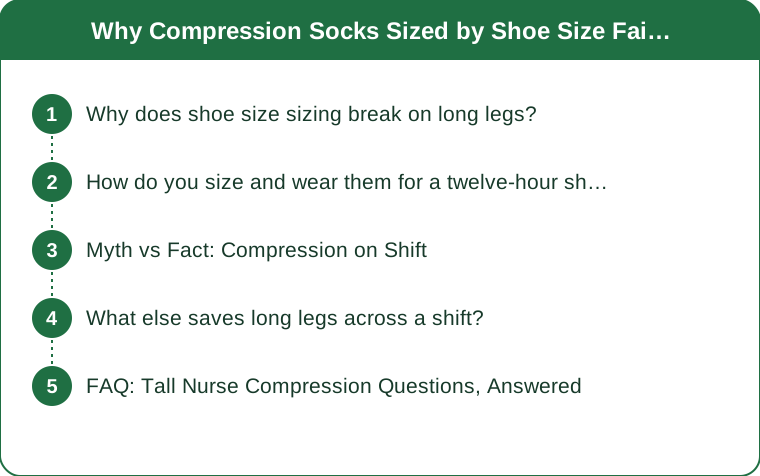
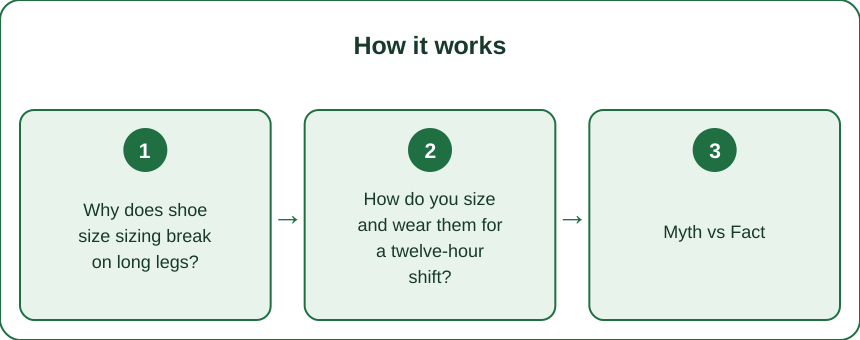
Why does shoe size sizing break on long legs?
Because compression is a location technology, and shoe size carries no location data.
A graduated sock is a machine with a map. Real compression socks are knitted so pressure is highest at the ankle and decreases up the leg — that gradient is what argues with gravity, supporting the veins’ return trip and discouraging fluid from pooling at the ankle through a long standing shift.
The map is drafted on an average leg. The knitting program assumes the ankle zone, the calf-belly zone, and the below-knee band will land on those parts of an average-length leg. On a long lower leg, everything lands low: the band meant to rest in the natural hollow below the knee stops at the widest part of the calf, and the gentlest pressure zone sits where a stronger one should.
A band parked on the calf belly is the classic tall failure. The muscle bulges above and below it, the band works like a soft tourniquet across the widest point, and by hour six there is a deep red groove and an odd heaviness below it — the sock is now mildly obstructing what it was meant to assist.
Rolling and sliding follow geometry too. A too-short sock stretched up a long calf is under constant downward tension, so it creeps, rolls at the top, and bunches at the ankle — and a rolled edge doubles the pressure line it creates.
None of this means compression is wrong for you. It means the sock was measured against the wrong body part — the foot — when the working part was the leg.
How do you size and wear them for a twelve-hour shift?
Three measurements, morning numbers, and a donning routine that survives a 6:30am start.
Measure in the morning, when legs are least swollen: ankle circumference at the narrowest point above the bone; calf circumference at the widest point; and knee height — floor to the bend of the knee, seated with the foot flat. That third number is the one long-legged buyers need most and most charts ignore.
Buy by the chart, not the size name. Good brands publish ankle and calf ranges per size, and the better ones offer tall or long lengths for exactly this problem. If a brand sizes only by shoe size, it is not built for your leg — move on. Between sizes, prioritise the calf number for fit and the length for band placement.
Pick the class for the job. Everyday shift wear for healthy legs is the light-to-moderate range — commonly 15 to 20 mmHg. Firmer medical classes exist for diagnosed conditions and belong in a conversation with a clinician, not a cart.
Features worth the money for long legs: a wide, soft-knit top band that grips without biting; real heel construction so the length lands where designed; toe seams that lie flat through a shift; and fabric with enough elastane recovery to hold the gradient past lunchtime.
Don and doff like it matters. Put them on before the shift starts, on dry legs, turning the sock inside-out to the heel and rolling it up rather than hauling the band. Smooth the fabric so no zone doubles up — wrinkles are pressure lines. At shift’s end, off before the couch, and give legs ten minutes elevated.
Rotate three pairs minimum. Compression fades with wear and washing; rotation plus cold washing and air drying keeps the gradient honest for months instead of weeks.

Myth vs Fact: Compression on Shift
Myth: Tighter is better. Fact: The therapy is the gradient, not the squeeze. Too-tight socks — or right socks in the wrong length — concentrate pressure in bands, which is the opposite of graduated. Correct size at moderate pressure outperforms heroic tightness every shift.
Myth: Compression socks are for people with vein problems. Fact: They are standard equipment for standing professions. Long shifts on hard floors produce ankle swelling and heavy legs in perfectly healthy people, and moderate graduated compression measurably reduces both. Prevention is the mainstream use, not the exception.
Myth: If they leave deep marks, they are working. Fact: A faint fabric imprint is normal; a deep groove at mid-calf with puffiness above or below means the band is in the wrong place — almost always a length problem on tall wearers. Working socks feel snug and even, and disappear from your awareness.
Myth: Sitting breaks make compression unnecessary. Fact: Breaks help, and twelve hours is still twelve hours. The socks work all shift including the stretches when the unit is too busy for the break you were promised.
Myth: Compression leggings do the same job. Fact: Athletic compression leggings apply general, roughly even pressure for muscle support — useful, but not graduated. They are a fine commute-and-recovery layer over the top; they are not the ankle-up gradient that fights all-day pooling. Different tools, and on shift the sock is the one doing the vascular work.
What else saves long legs across a shift?
The socks are one leg of a four-part strategy.
Work the calf pump on the clock. The calf muscle is the second heart for venous return, and it only pumps when it moves. Ten heel raises at the med room, ankle circles while charting, a toe-tap habit at the nurses’ station — thirty seconds hourly beats one break-room stretch, and tall legs, with the longest columns of blood to lift, benefit most.
Rotate two pairs of shoes across the week. Cushioning recovers between wears, and alternating changes the micro-mechanics of standing enough to move the load around. Worn-flat shoes concentrate strain the socks then have to argue with.
Get the hem length right so the system works together. Scrub pants that are too short for long legs pull the eye to the sock band all shift; tall-inseam scrub pants — or full-length leggings under scrub dresses where your unit’s dress code allows athletic underlayers — keep the compression invisible and the look professional. The tall problem and the compression problem are solved by the same habit: buy for your actual leg length.
End the shift with two minutes of drainage. Legs up the wall or heels on the couch arm, ten slow breaths — gravity finally working for you. Off-shift training does the long-term version: strong calves and hips are the durable fix for standing-profession legs.
And know the red flags that outrank all of it. New one-sided swelling, calf pain or warmth, skin colour changes, numbness, or swelling that does not resolve overnight — those are clinician conversations, not sock adjustments. If you have diabetes, peripheral artery disease, or neuropathy, get sizing and pressure class guidance from a professional first. This is general information, not medical advice.
FAQ: Tall Nurse Compression Questions, Answered
My compression socks always end mid-calf. Size up or brand change?
Brand change. Sizing up increases circumference, not length, so you trade the digging band for a loose gradient — both wrong. You need brands publishing knee-height or offering tall lengths; the length problem is solved in the catalogue, not the size chart.
How tight should the top band feel?
Present but forgettable: snug contact below the knee, no bite, no roll, and at shift’s end an imprint rather than a groove. If you are re-seating it hourly or feel relief the second it comes off, the size or length is wrong.
Knee-high or thigh-high for shift work?
Knee-high is the standard for occupational swelling — ankle-to-knee is where shift pooling happens, and knee-highs stay put on long legs far better than thigh styles. Thigh and full styles belong to specific medical situations and clinician guidance.
When should I put them on and take them off?
On before the shift — legs at their least swollen, ideally soon after waking — and off when the standing day ends. Wearing them for the commute home is fine; sleeping in occupational-grade compression is unnecessary unless a clinician has told you otherwise.
TL;DR:
- Graduated socks are a pressure map drafted for average leg length; shoe-size sizing lands the map low on long legs, parking the top band on the calf belly where it digs and mildly obstructs.
- Size by three morning measurements — ankle, calf, knee height — and only buy brands that publish them or offer tall lengths.
- Moderate pressure, wide soft bands, three-pair rotation, cold wash, and on-before-shift timing keep the gradient honest for a full twelve hours.
- Hourly calf-pump micro-moves, rotated shoes, tall-inseam scrubs, and end-of-shift elevation complete the system; one-sided swelling or calf pain is a clinician’s case, not a sock’s.
Measure your knee height tonight and check it against your current brand’s chart. Most tall nurses discover they have been wearing a size that was never on their leg’s map.
See It in Motion
Seen here: High Waist Yoga Leggings with Side Pockets — shop it on bubblelime.com
Keep Reading
This article is for general informational and styling purposes only. Fit, sizing, and product availability may vary.
