Why Standard Arch Support Doesn't Hold Up for Tall Nurses on 12-Hour Shifts
Quick Answer: Taller nurses carry more body weight over the same relative foot surface area, generating more cumulative pressure on the arch through a 12-hour shift than standard shoe arch support (calibrated to average body weight) is designed to handle — shoes with higher-density, taller-specific or adjustable arch support, or added custom orthotic inserts, address this more effectively than generic nursing shoes.
Generic arch support recommendations for nursing shoes don’t usually account for how a taller frame changes the actual load on the arch over a full standing shift.

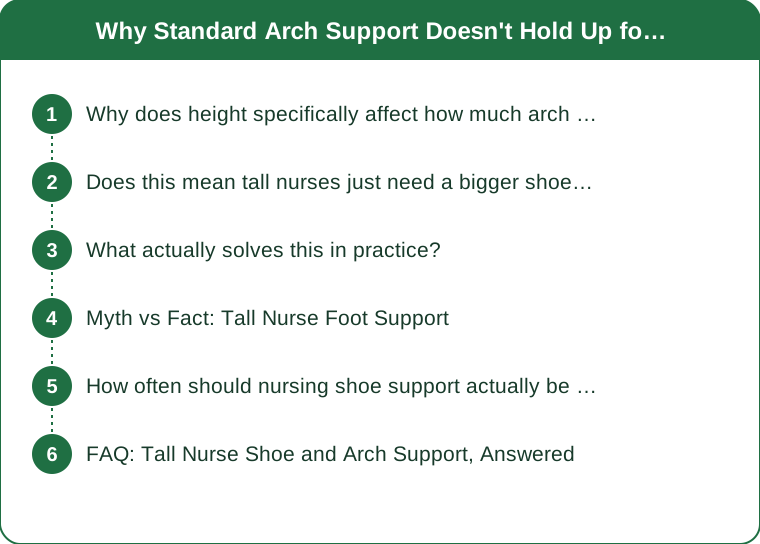
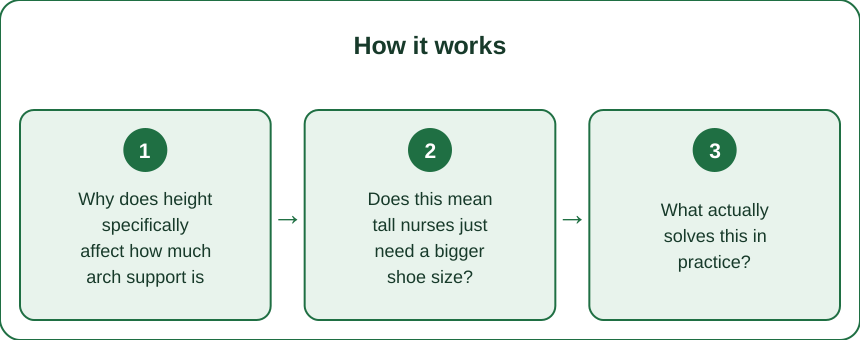
Why does height specifically affect how much arch support is needed?
A taller frame typically carries proportionally more body weight, which translates to more cumulative downward pressure on the arch over hours of standing and walking, compared to a shorter, lighter frame in the same generic shoe. Standard shoe arch support is generally built and tested around an average body weight range, which doesn’t fully account for the higher end of that distribution.
Does this mean tall nurses just need a bigger shoe size?
Not primarily — it’s about support density and structure, not just size. A larger shoe size doesn’t inherently add more or firmer arch support; it’s the same support material scaled to a longer shoe, not reinforced for higher load. Support quality and structure matter more than size scaling alone for addressing this specific issue.
What actually solves this in practice?
Custom or semi-custom orthotic inserts, fitted specifically to individual arch height and weight distribution, provide more targeted support than a shoe’s built-in arch support alone, regardless of shoe brand. Nursing shoes marketed specifically for high-impact, extended-wear use (rather than general comfort shoes) tend to use denser, more structured support materials that hold up better under higher cumulative load over a 12-hour shift.

Myth vs Fact: Tall Nurse Foot Support
Myth: “Any shoe labeled ‘arch support’ provides adequate support regardless of body weight.” Fact: support density and structure vary significantly between products, and what’s adequate for a lighter frame can compress and flatten faster under a heavier, taller frame’s cumulative load.
Myth: “Custom orthotics are only for people with diagnosed foot problems.” Fact: many nurses use custom or semi-custom orthotics purely as a preventive, load-distribution measure, without any specific diagnosed condition.
Myth: “A more expensive nursing shoe automatically means better arch support for a taller frame.” Fact: price doesn’t reliably correlate with support density — checking specific support material and structure, not just price point or brand reputation, is what actually matters.
How often should nursing shoe support actually be reassessed or replaced?
Arch support material compresses and degrades over time with regular use, often before the outer shoe looks visibly worn — many podiatrists suggest reassessing support (or replacing inserts) roughly every six months for nurses on their feet most of a 12-hour shift, since compressed support silently stops doing its job well before it’s obviously worn out.
FAQ: Tall Nurse Shoe and Arch Support, Answered
Is it worth seeing a podiatrist specifically about this, or can it be solved with better shoes alone?
For persistent pain, a podiatrist evaluation is worth it — they can assess actual arch type and weight distribution and recommend truly custom support, which off-the-shelf solutions can only approximate.
Do compression socks help with this issue too, or is that unrelated?
Related but addressing a different mechanism — compression socks help circulation and swelling, while arch support addresses structural load distribution; many tall nurses benefit from using both together.
Should shoe replacement frequency be different for taller nurses?
Often yes, given faster support material compression under higher cumulative load — replacing nursing shoes or inserts somewhat more frequently than a standard recommendation is reasonable for anyone carrying above-average weight through long standing shifts.
TL;DR:
- Taller nurses generate more cumulative arch pressure over a shift than standard shoe support is built for
- The fix is about support density and structure, not simply sizing up
- Custom or semi-custom orthotics and high-impact-rated nursing shoes address the load issue more directly
- Support material compresses over time — reassessing roughly every six months prevents silent support loss
Persistent foot fatigue on 12-hour shifts isn’t just a nursing hazard to accept — for taller nurses specifically, it’s often a fixable mismatch between actual load and generic support.
Keep Reading
This article is for general informational and styling purposes only. Fit, sizing, and product availability may vary.
