Why Tall Nurses' Scrub Top Sleeves Always Ride Up Mid-Shift
Quick Answer: Standard scrub top sleeves are cut short relative to a tall nurse’s arm length, and the constant reaching, lifting, and repositioning during a shift pulls them up further, exposing forearms even when the top fit fine at the start of the day.
You checked the mirror before your shift and the sleeves looked fine. Four hours and a dozen reaches into an overhead cabinet later, they’ve crept up to your elbows and stayed there.

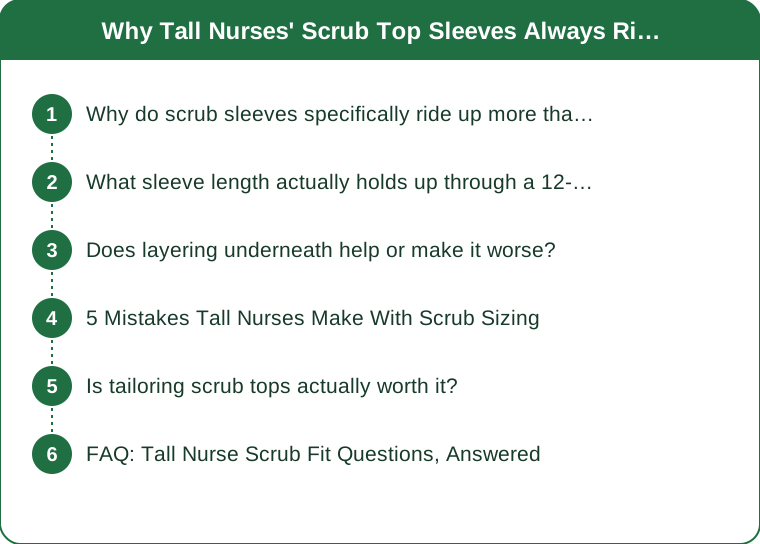
Why do scrub sleeves specifically ride up more than regular shirtsleeves?
Scrub tops are typically cut with a looser, boxier sleeve than a fitted shirt, which is great for range of motion but means there’s more excess fabric to shift and bunch during repeated overhead or forward reaching. On a tall frame with proportionally longer arms, that sleeve was already shorter relative to arm length before the shift even started, so there’s less margin before it becomes visibly short.
The repeated motion of a nursing shift — reaching, lifting, repositioning patients — is more physically dynamic than most jobs, which means sleeves get tested by movement far more than a typical office shirt ever would.
What sleeve length actually holds up through a 12-hour shift?
Looking for scrub tops labeled ‘tall’ sizing specifically (not just a larger regular size) is the most direct fix, since tall scrub lines adjust sleeve length proportionally rather than just adding overall fabric volume. A regular top sized up for length often ends up too wide in the body while still falling short on the sleeve.
A slightly fitted sleeve cuff (rather than a loose, open sleeve) also helps it stay in place through movement, since there’s less loose fabric for the motion to catch and drag upward.
Does layering underneath help or make it worse?
A fitted long-sleeve compression top underneath solves the exposure problem even if the scrub sleeve itself still creeps up, since your arms stay covered either way. Many hospitals allow a solid-color long-sleeve undershirt as long as it meets dress code, making this one of the most practical fixes that doesn’t require buying new scrubs.
Bulkier layers underneath can make the problem worse, though, since they add extra fabric bunching under an already-short sleeve — a thin, fitted layer works better than a loose one.

5 Mistakes Tall Nurses Make With Scrub Sizing
Sizing up for sleeve length and getting a boxy body fit instead. This trades one problem for another without fixing the actual issue.
Assuming all ‘tall’ labeled scrubs are actually cut proportionally longer in the sleeve. Some tall lines only add torso length, not sleeve length — checking the actual sleeve measurement matters.
Not accounting for shrinkage after hospital-grade laundering. Industrial washing can shrink sleeves further over time, even in tall-cut styles.
Choosing style over function for sleeve cuff design. A wide, loose cuff looks relaxed but rides up faster than a fitted one during active shifts.
Not layering with a compression top as a backup. Even a well-fitted scrub top can ride up during a long shift — having a base layer solves the coverage issue regardless.
Is tailoring scrub tops actually worth it?
For nurses who’ve found a scrub top brand that fits well everywhere except sleeve length, having a tailor add an inch or two to the sleeve (using matching fabric from the hem if needed) is a relatively inexpensive fix, usually $15-25, that saves repurchasing an entire uniform line. It only works if there’s fabric to work with, so it’s worth asking a tailor to assess before committing.
For nurses buying new, it’s usually more cost-effective to find a tall-specific scrub brand upfront rather than planning to alter standard sizes repeatedly.
FAQ: Tall Nurse Scrub Fit Questions, Answered
Are there scrub brands that specifically size for tall proportions?
Yes — several medical apparel brands offer a genuine ‘tall’ size category with proportionally longer sleeves and torso, distinct from just a larger regular size.
Does sleeve length affect infection control compliance?
In most settings, standard scrub sleeves (whether they ride up or not) are already above the wrist per hand hygiene protocols, so this is primarily a comfort and coverage issue rather than a compliance one — check your facility’s specific dress code either way.
Will a stretch-fabric scrub top help more than a stiffer one?
Often yes — a four-way stretch fabric tends to move with your arm during reaching rather than being pulled up as rigidly as a stiffer cotton-blend scrub.
TL;DR:
- Scrub sleeves are cut looser than fitted shirts, giving more fabric to shift during a physically active shift
- True tall-sized scrub lines adjust sleeve length proportionally, not just overall size
- A thin, fitted compression layer underneath solves exposure even if the scrub sleeve still rides up
- Tailoring an extra inch onto a well-fitting scrub top is often cheaper than replacing the whole line
A sleeve that looked fine at the start of your shift isn’t a fit failure — it’s just standard sizing meeting twelve hours of real movement, and there are practical fixes for both.
Keep Reading
This article is for general informational and styling purposes only. Fit, sizing, and product availability may vary.
