Why Tall Nurses Should Size Scrub Pants by Rise, Not Inseam
Quick Answer: Tall scrub ranges add inseam length and usually add little or no rise, so on a long torso the waistband sits below your natural waist — where it has no narrowing to sit on and slides down every time you bend. Rise is the measurement that determines whether scrubs stay up over a twelve-hour shift, and it is almost never listed. Measure your own rise, then buy by brand knowledge rather than by size chart.
The inseam is finally right. They are still around your hips by lunchtime, and you are hitching them up between rooms all afternoon.

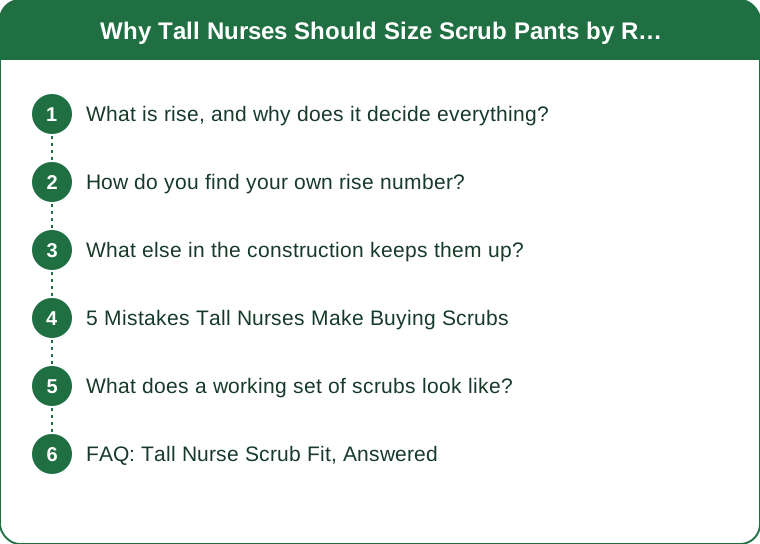
What is rise, and why does it decide everything?
It is the vertical distance from the crotch seam to the top of the waistband, and it sets where the waistband lands on your body.
Front rise is measured from the crotch seam up the centre front to the top edge. A typical scrub pant has a front rise around 10 to 12 inches, which places the waistband somewhere on the hip or lower abdomen for most people.
On a long torso, the same rise lands lower. Your crotch-to-waist distance is longer, so a fixed rise finishes further from your natural waist — often 2 to 4 inches below it. That is the whole mechanism.
Why landing low is the problem: your natural waist is the narrowest point of your torso, and a waistband sitting there has something to grip. A waistband sitting below it is on a widening surface, so gravity plus any movement pushes it down and it has nothing to catch on. This is why they slide — not because the drawstring is loose.
Then the shift makes it continuous. Every time you bend, squat, kneel, reach, or lift, the waistband is displaced downward slightly, and there is no narrowing to stop it. Over twelve hours of a nursing shift that is hundreds of small displacements.
And here is why tall ranges do not solve it. A Tall size adds inseam — typically 2 inches — and adds rise sparingly or not at all. So you get the leg length and the waistband still sits low. You have fixed the visible problem and left the one that actually causes the sliding.
A rough guide to what you need: for most people over about 5’9 with a longer torso, a front rise of 12 to 14 inches puts the waistband at or near the natural waist. That is a high-rise or mid-rise-plus specification, and it is rarely marketed to nurses.
How do you find your own rise number?
One measurement, taken once, that then works across every brand.
Measure a pair of trousers that already fit you well — this is far more reliable than measuring your body.
- Lay the trousers flat, front side up, waistband closed.
- Measure from the crotch seam straight up the centre front to the top of the waistband. That is the front rise.
- Do the same on the back, crotch seam to top of the waistband at centre back. That is the back rise.
- Write both numbers down in your phone.
Back rise matters more than most people realise. A longer back rise is what stops the waistband dropping at the back when you bend forward — which is most of what a nurse does all day. A pair with a back rise 2 to 3 inches longer than the front is doing real work, and a pair with nearly equal front and back rise will gap at the back every time you lean over a bed.
Then use the numbers as a filter. Some scrub brands publish rise in their size charts and most do not. For those that do, you can shop directly. For those that do not, measure the first pair you receive and note it against the brand and style, and you will build a personal reference in three or four purchases.
The keyword that helps most: search for high rise scrub pants rather than tall scrub pants. High rise addresses the actual variable, and combining a high rise with a tall inseam is what you want. Some brands now list both, and those are the ones worth staying loyal to.
What else in the construction keeps them up?
Four features, in descending order of how much difference they make.
1. A wide knit waistband, or a yoga-style waistband. A 2 to 3 inch knit band grips over a much larger area than a thin elasticated one and distributes pressure, so it does not roll or dig. This is the single most effective construction feature for a long torso and it is why yoga-waist scrubs became popular so quickly.
2. A drawstring plus elastic, not one or the other. Elastic alone slides; drawstring alone digs. Together, the elastic holds the shape and the drawstring stops the descent. Check that the drawstring is anchored — a free-floating cord disappears inside the casing on the first wash and is a genuine daily annoyance.
3. Back rise longer than front rise. As above. Look at the pants on a hanger from the side — if the back waistband sits visibly higher than the front, that is the design you want.
4. Fabric with recovery, not just stretch. Stretch lets fabric move; recovery is what returns it. A four-way stretch with a decent elastane content — around 4 to 8% — holds its shape through a shift, where a low-elastane fabric bags out by hour six and never recovers until it is washed.
Two things that matter less than the marketing suggests: pocket count, which is genuinely useful but has no bearing on whether they stay up, and jogger versus straight leg, which is a preference. A jogger cuff does help with the shoe-and-hem problem for tall wearers, since the cuff sits wherever your ankle is rather than needing a specific length.
And one that matters more than expected: the crotch construction. A gusseted crotch means the seam does not pull downward when you squat, which is a meaningful part of why some pants stay put through kneeling and others do not.

5 Mistakes Tall Nurses Make Buying Scrubs
1. Buying by inseam alone. Inseam solves the hem and does nothing about the sliding. Rise is the variable that decides whether you spend the shift hitching them up.
2. Sizing up to get more length. A larger size adds width everywhere and adds almost no rise, so you end up with a loose waistband sitting in the same low position — which slides faster, not slower. Rise and inseam are the two numbers; waist size is a third and separate one.
3. Tightening the drawstring as the fix. A waistband below the natural waist slides because of where it sits, not because of how tight it is. Cinching it harder produces digging and discomfort without stopping the descent, and it is why so many people finish a shift with a red line across their hips.
4. Assuming one brand’s tall fits like another’s. Tall specifications vary widely — some add 2 inches of inseam and nothing else, some add rise as well, some just make the whole garment larger. Measure every new pair when it arrives and keep the note.
5. Ignoring the shoe interaction. A pant hemmed for one shoe height puddles or rides with another, and nurses change shoes more than most people. A jogger cuff or a slightly shorter straight leg with a defined ankle is more forgiving across the two or three pairs of shoes you actually rotate.
What does a working set of scrubs look like?
Three or four pairs of one proven style, and a system for finding the next one.
When you find a pair that works, buy multiples immediately. Scrub styles are discontinued and reformulated constantly, and the pair that finally fits will not be available in eighteen months. This is the single most practical piece of advice on the page and nearly every tall nurse learns it the hard way once.
What to look for, as a checklist:
- Front rise 12 inches or more, back rise longer than front
- Tall inseam, or a jogger cuff that makes inseam less critical
- Wide knit or yoga waistband with anchored drawstring plus elastic
- 4 to 8% elastane with genuine recovery
- Gusseted crotch
How to shop when the rise is not published:
- Order one pair, not four.
- Measure the rise when it arrives, before washing.
- Wear it one full shift, because bagging out by hour eight is not visible in a fitting room.
- Then buy the multiples, and note the brand, style, size, and rise in your phone.
Two care habits that extend the life of the ones that work. Wash cool and skip the hot dryer — heat degrades elastane, and dead elastane means a waistband that no longer recovers, which brings the sliding back on a pair that used to be fine. And rotate pairs rather than wearing a favourite two shifts running, because elastane needs time to recover its shape.
Seasonal note: heading into autumn and winter, layering a long-sleeve tee under scrubs adds bulk at the waistband and can change how a marginal pair behaves. A fitted base layer tucked in works better than a loose one, which bunches at exactly the point where the waistband needed a clean surface to grip. If your scrubs cause persistent digging, numbness at the waist, or skin irritation over a long shift, that is worth changing rather than tolerating.
FAQ: Tall Nurse Scrub Fit, Answered
What rise should I look for if I am 5’11?
Measure a pair of your own trousers that sit where you want them and use that number rather than a general rule. As a starting point, most people at that height with a long torso are comfortable with a front rise of around 12 to 14 inches, and the back rise mattering as much or more. If a brand publishes rise, that is a reason to buy from them.
Are yoga-waistband scrubs actually better or just a trend?
Genuinely better for this specific problem. A wide knit band grips over a larger area, does not roll, and distributes pressure instead of concentrating it in a thin line — which is exactly what a long torso and a full shift require. The tradeoff is that some hospitals have uniform policies about waistband style, so check first.
Why do my scrubs fit at the start of a shift and sag by the end?
Fabric recovery. Stretch fabric elongates under repeated load and returns to shape only if it has enough elastane and that elastane is still intact. Low-elastane fabrics bag out over hours, and any fabric that has been through repeated hot drying loses recovery permanently. Washing cool, air drying, and rotating pairs makes a noticeable difference to how a pair behaves at hour ten.
TL;DR:
- Tall scrub ranges add inseam and rarely add rise, so the waistband still lands below your natural waist on a long torso
- A waistband below the waist sits on a widening surface with nothing to grip, which is why it slides regardless of drawstring tension
- Measure the front and back rise of a pair that fits you, write both down, and shop by that number — search high rise, not just tall
- Look for a wide knit waistband, anchored drawstring plus elastic, back rise longer than front, 4 to 8% elastane, and a gusset
- Order one pair, wear a full shift, then buy multiples — the style will be discontinued before you need the next one
The inseam was the visible problem and the rise was the real one. Get the waistband to your actual waist and the hitching-up between rooms simply stops, which over twelve hours is a bigger upgrade than any pocket count.
See It in Motion
Seen here: Yoga Jogger Sweatpants with Pockets — shop it on bubblelime.com
Keep Reading
This article is for general informational and styling purposes only. Fit, sizing, and product availability may vary.
