Why Monitors and IV Poles Cost Tall Nurses Their Necks
Quick Answer: Wall-mounted monitors, infusion pumps and IV pole displays are installed at heights standardised around an average user, which for a taller nurse means a sustained downward head tilt every time they are checked. Every fifteen degrees of forward head tilt roughly doubles the effective load on the neck, and across a twelve-hour shift that is hundreds of repetitions. The fixes are positional rather than structural: step back rather than closer, raise pole displays where they adjust, and use the bed height to change your own working level.
Equipment height is the ergonomic problem nurses have least control over and the one that compounds fastest.
This blog has covered why bending over a low bed costs more than lifting does, med cart height mismatch, and workstation cart adjustments. Fixed wall equipment is the remaining piece.
Why does a small downward tilt cost so much?
Because the head is heavy and the neck is a lever with very little mechanical advantage.
A neutral head loads the cervical spine with roughly its own weight. Tilt it forward fifteen degrees and the effective load approximately doubles; at forty-five degrees it is several times higher.
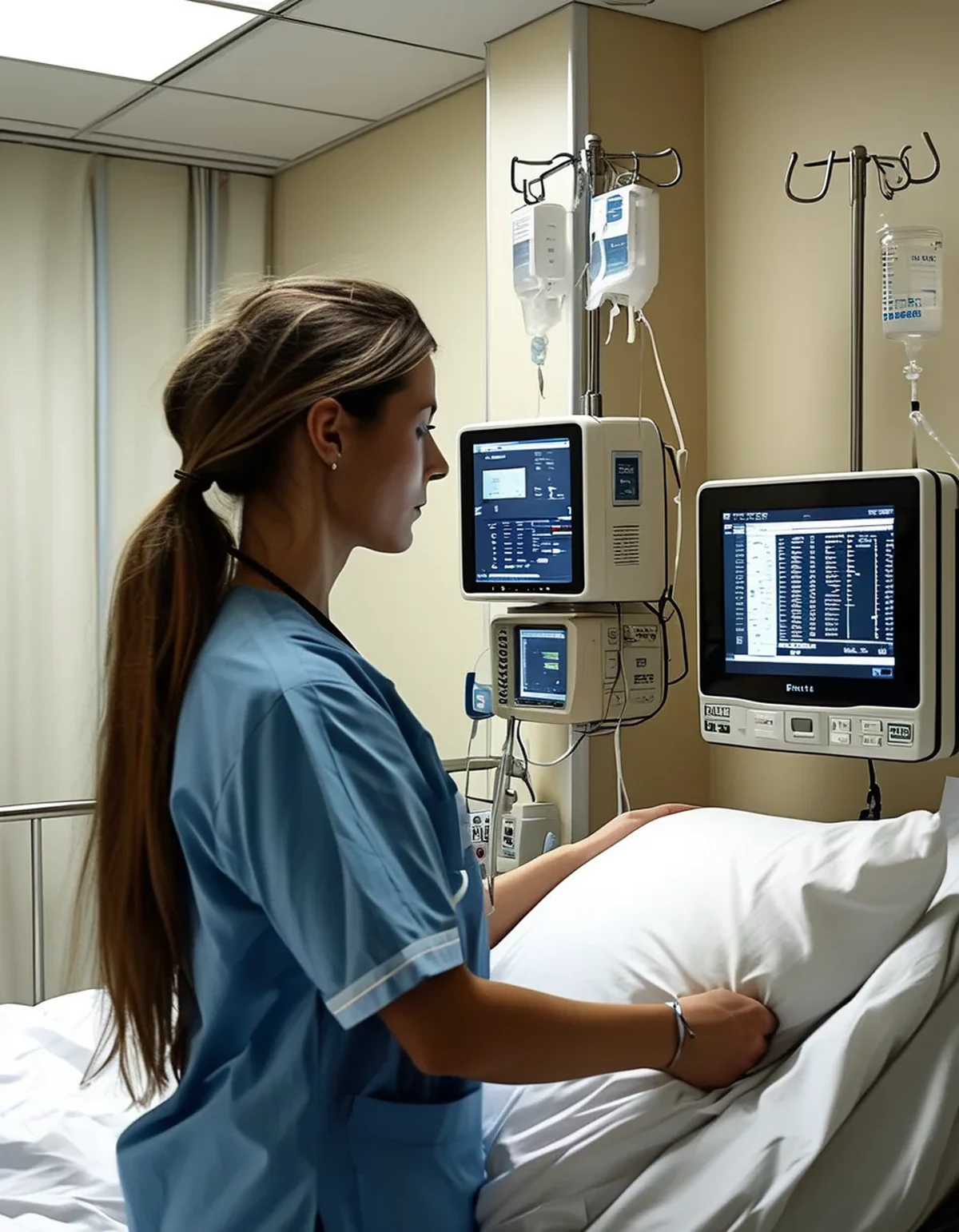
A taller nurse tilts further for the same fixed screen. The height difference between you and the design assumption converts directly into degrees of tilt.
The tilt is sustained rather than momentary. Reading a monitor takes several seconds, checking a pump takes longer, and across a shift those seconds accumulate into a substantial total.
The upper trapezius and levator scapulae hold the position isometrically, which fatigues them without the blood flow that rhythmic work provides.
Shoulder elevation usually comes with it. Reaching to adjust a pump while looking down adds a shrug to the tilt, which is the combination that produces the classic end-of-shift ache between the shoulder and the neck.
And it stacks with everything else. Charting, bed work, patient transfers and phone use all add flexion in the same direction across the same twelve hours.
What you can actually change on a ward
Six adjustments that do not require anyone to move a wall bracket.
Step back rather than closer. Distance flattens the viewing angle. Standing a metre back from a wall monitor requires far less tilt than standing directly beneath it.
Raise the display on IV poles and pumps where they adjust. Many pole-mounted pumps slide vertically and are simply left where the last person set them.
Use bed height as your own height adjustment. Raising the bed for a task also raises your natural line of sight relative to fixed equipment nearby.
Turn towards the screen rather than turning your eyes. Rotating the whole body avoids the combined tilt-and-rotate position, which is the most loaded of all.
Break the position every few seconds. Look up and away briefly during long reads. Sustained isometric load is the problem, so interrupting it matters more than the total time.
And reset shared equipment when you set it. Leaving a pole display at your height is not selfish; the next person adjusts it in two seconds either way.
Where a wall bracket is genuinely at a bad height for several staff, it is worth raising formally through whoever handles equipment on your unit. Brackets get moved when someone asks, and often not otherwise.

What Nobody Tells You About Twelve-Hour Neck Load
The ache arrives after the shift, not during it. Isometric postural load presents late, which is why most people never connect it to the specific positions that caused it.
It is cumulative across days, not just hours. Four consecutive shifts produce a different level of fatigue from one, and the recovery window between them is where the difference is made or lost.
Your phone is doing the same thing on your break. Twenty minutes of looking down at a phone in the staff room is the same posture as the one you are trying to escape.
Height at the workstation matters more than the chair. Most nurses adjust the chair and leave the monitor, when the monitor is the piece determining head position.
Strength work helps but positioning helps faster. Deep neck flexor and mid-back work is genuinely useful over months; moving a pump display up ten centimetres helps tonight.
And the first sign is usually a headache rather than neck pain. Tension headaches at the end of a run of shifts are frequently cervical in origin, and they respond to the same fixes.
This is general information, not medical advice. Neck pain with arm symptoms, numbness or weakness should be assessed rather than managed with positioning alone.
A shift routine that limits the accumulation
Seven habits, none of which cost time.
Set your bed height for every task rather than for the shift. Higher for anything at chest level, lower for anything you lean over.
Adjust pole-mounted displays at the start of your round rather than tilting to read them each time.
Stand back from wall screens and let distance do the work instead of your neck.
Do a chin tuck between tasks. Chin drawn straight back, three seconds, a few times per hour. It directly counteracts the forward head position.
Look up and out of a window for thirty seconds a few times a shift. It resets both the neck and the eyes, and the eye component of head tilt is larger than most people realise.
Keep the phone at eye level on breaks. Twelve hours of ward posture followed by twenty minutes of the same posture on a break is a wasted recovery window.
And add two short mid-back sessions a week. Rows, band pull-aparts and thoracic extension work build the capacity to hold a neutral head position for longer, which is the durable version of the fix.
FAQ: Nurse Neck Strain Questions, Answered
Why does my neck hurt more than my back after a shift?
Because fixed-height equipment forces a sustained downward head tilt, and every fifteen degrees of forward tilt roughly doubles the effective load on the cervical spine. Taller staff tilt further for the same screen height.
Can I do anything about wall-mounted monitor heights?
Positionally, yes — step back to flatten the viewing angle rather than standing directly beneath the screen. Structurally, brackets do get moved when someone raises it formally, and it is worth asking if several staff are affected.
Do chin tucks actually help?
For postural neck fatigue, yes. A few sets of three-second chin tucks per shift directly counteract the sustained forward head position, and they take seconds. They are not a treatment for pain with arm symptoms, which needs assessing.
TL;DR:
- Fifteen degrees of forward head tilt roughly doubles cervical load, and a taller nurse tilts further at the same fixed screen.
- Step back from wall monitors rather than standing under them. Distance flattens the angle.
- Raise pole and pump displays at the start of your round instead of tilting to read them all shift.
- Chin tucks between tasks, and keep the phone at eye level on breaks.
The bed you can adjust. The wall you cannot — so adjust where you stand.
Keep Reading
This article is for general informational and styling purposes only. Fit, sizing, and product availability may vary.
