Compressions, Bed Height, and Why Being Tall Changes the Mechanics
Quick Answer: Effective compressions require your shoulders stacked directly over your hands with straight arms, so your body weight does the work instead of your arms. On a bed that is too low for your height, you either bend your elbows — which fatigues you fast and reduces depth — or flex at the spine, which is worse for you and less effective. The answers are raising the bed, kneeling on it, or using a step stool, decided in advance rather than mid-code.
Everyone talks about bed height for back safety during transfers. Almost nobody talks about it for compressions, and it is the one place where the mechanics are least forgiving.
Compressions are a whole-body technique that depends on a specific geometry, and if you are tall, the standard geometry is available to you less often than it is to your colleagues. The third section covers what actually degrades when the height is wrong, which is not what most people assume.

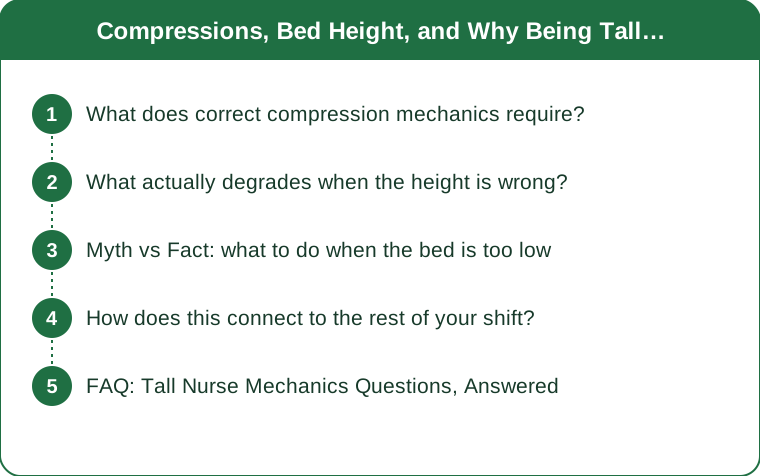
What does correct compression mechanics require?
Three positional elements, and all three are height-dependent.
Shoulders directly over the hands. The line from your shoulder through your elbow to your wrist should be vertical. This lets you compress by shifting your bodyweight forward and down rather than by pushing with your arms.
Elbows locked straight. A bent elbow means your triceps are doing the work. Arms fatigue within a couple of minutes; body weight does not.
Hinge from the hips, spine relatively neutral. Your trunk moves as a unit rather than flexing segment by segment.
For that geometry to be available, the patient’s chest needs to be at roughly the right height relative to your own body — low enough that you can get your shoulders over it with straight arms, without having to bend your knees dramatically or fold at the waist.
For a taller provider, standing beside a bed at typical height, the chest is often too low. To get shoulders over hands with straight arms, you would need the bed higher than it commonly sits, or yourself lower.
So one of three things happens: you bend your elbows, you flex your spine, or you find a way to change the height. The first two are the ones that happen by default, and both are worse than they look.
What actually degrades when the height is wrong?
Not what most people expect, and this is the part worth internalizing.
Depth suffers first, and you will not feel it. Compression depth is what drives perfusion, and it is the metric most sensitive to mechanics. When you push with your arms instead of your body weight, you generate less force and it declines as your arms fatigue. The provider generally cannot perceive this decline, which is precisely why feedback devices exist.
Full recoil suffers second. Allowing the chest to fully recoil between compressions is as important as the depth, because recoil is what allows the heart to refill. Bent-arm compressions from an awkward angle tend to lean, reducing recoil.
Rate drifts. Fatigue and awkward mechanics both push rate off target.
And you fatigue faster. Guidelines recommend rotating compressors approximately every two minutes precisely because quality degrades with fatigue. Poor mechanics compress that window — you may be degrading well before the rotation point.
The consequence for a taller provider is specific: if you are working in a bent-arm posture because of bed height, you are probably delivering lower-quality compressions than you believe you are, and degrading faster than the standard rotation interval assumes.
Your own body pays too. Sustained spinal flexion under load, repeated at over a hundred compressions per minute, is one of the highest-risk postures in clinical work — and a longer spine means more to control.

Myth vs Fact: what to do when the bed is too low
Myth: You should just get lower — bend your knees, widen your stance, and make it work.
Fact: Widening your stance and bending your knees is a partial fix that fails as you fatigue, and there are three better options you should have chosen between in advance.
Bending the knees does lower your shoulders, and it is far better than folding at the spine. But holding a deep partial squat while delivering compressions is metabolically expensive, and as your legs tire you rise, your elbows bend, and you are back in the bad position without noticing the transition.
The three real options, in rough order of preference:
1. Raise the bed. The simplest and most often forgotten. Bed height is adjustable and adjusting it takes a moment. In a code this is a legitimate, fast intervention and it improves compression quality for whoever is on the chest. Set it so the compressor’s mechanics work, and re-set it when compressors rotate if they differ in height.
2. Kneel on the bed. Widely taught and appropriate when the bed cannot be raised enough or when the patient’s position makes it awkward. It puts you directly above the chest with a straight-arm position available. The considerations are bed stability and space.
3. Use a step stool — for shorter providers, not taller ones. Worth naming explicitly because it is the standard answer and it is the wrong direction for you. A stool raises the provider, which is what a shorter colleague needs. A tall provider needs the patient raised, not themselves.
The pre-decision is the actual recommendation. Know your own answer before you need it: know how high your units’ beds go, know whether kneeling is practical on them, and know where the backboard is. A code is not the moment to work out your ergonomics from first principles.
This is general information about mechanics and is not a substitute for your institution’s protocols or your current resuscitation certification.
How does this connect to the rest of your shift?
Compressions are the extreme case of a pattern that runs through the whole job for a taller nurse.
Bed height is the master variable. Wound care, line placement, assessments, bathing, positioning — every task performed at a bed is a task performed at a height set for someone else unless you set it. The habit worth building is adjusting the bed at the start of every task, not just for transfers. It takes two seconds and it is the single highest-value ergonomic behavior available to you.
The equivalent problem exists everywhere else. Med carts, computer workstations, and counters are all at fixed heights, and none of them were set for a longer torso. Where they are adjustable, adjust them. Where they are not, change your relationship to them — step back and reach rather than leaning in, or bring the work to you.
Watch the cumulative flexion. The reason back injury is so prevalent in nursing is not one heavy lift, it is thousands of small forward bends. A longer spine means a longer lever arm on every one of them, so identical work produces more load on you than on a shorter colleague.
Advocate at the unit level. If the beds on your unit do not go high enough, that is a real, specific, fixable equipment issue and it affects the tallest and shortest staff most. It is a reasonable thing to raise.
Protect the recovery side too. Compression sock length, supportive shoes, and scrub pants that actually reach are not vanity items on a twelve-hour shift — they are the difference between finishing the week functional and finishing it sore.
FAQ: Tall Nurse Mechanics Questions, Answered
Should I always kneel on the bed if I am tall?
Not always — it depends on the bed, the patient, and the space. It is one of your options and worth being comfortable with, but raising the bed is usually faster and less disruptive when the bed’s range allows it.
Does a mechanical compression device solve this?
Where available and appropriate, yes — it removes provider mechanics from the equation entirely. Availability and indication vary by setting and protocol, so it is not something to plan around.
How do I know if my compressions are actually deep enough?
Use feedback devices where your unit has them, and rotate on schedule regardless of how you feel. Self-assessment of compression quality is unreliable for everyone, which is exactly why the two-minute rotation exists.
TL;DR:
- Effective compressions need shoulders stacked over straight arms, and that geometry depends on bed height.
- A bed that is too low pushes you into bent elbows or spinal flexion, both of which reduce depth and recoil.
- Quality degrades before you feel it, and poor mechanics shorten your effective window below the rotation interval.
- Raise the bed or kneel on it — a step stool is the fix for shorter providers, not taller ones.
- Decide your approach in advance, and carry the bed-height habit into every task at the bedside.
The broader point is that most clinical ergonomics guidance is written for the middle of the height distribution, and if you are outside it, you have to do the translation yourself. That is not a small thing over a career. Get in the habit of touching the bed control before you touch the patient, know your own answer for a code before there is one, and raise the equipment issue with your unit — because you are almost certainly not the only person on the floor working around it.
Keep Reading
This article is for general informational and styling purposes only. Fit, sizing, and product availability may vary.
